
How many buses does a school run need?
The number of buses a school contract needs is set by its busiest moment, not its average. Every bus on the road at that moment needs a driver, fuel, a lease or a loan, and a spare behind it. One bus too many costs money every school day for the life of the contract. One bus too few, and students miss the bell.
Most school networks grow one route at a time. A new estate gets a new run, a school changes its bell and a route is stretched to fit. Each route works on its own, so nobody sees the bus that could cover two schools, or the two half-empty runs that could be one.
What decides how many buses you need
The count comes down to a handful of things, and they pull against each other.
The bell times. Two schools that start at the same time need two sets of buses. Two schools with staggered bells can share them, because a bus that finishes the early run can start the later one.
How early a bus may arrive. Most schools accept buses inside a window before the bell. The wider that window, the more pickups one bus can fit in before it has to be at the gate.
The longest ride you accept. A tight ride limit means shorter routes, and shorter routes mean more of them. Families feel a long ride; the contract feels every extra bus.
The size of your buses. A full-size bus on a run with a handful of students wastes seats, and a small bus on a busy run needs a second trip. Matching each run to the right vehicle changes the count.
Where students board. A stop at every gate makes every route longer. Shared stops within a short walk cut the stops a bus makes and the time it takes.
The roads in between. Running time comes from the roads a bus can drive and the turns it can make, plus the dead running from the depot to the first stop.
Morning and afternoon are different problems
Bells that are staggered in the morning can finish close together in the afternoon, so buses that are shared before school may not be shareable after it. The fleet a school network needs is the larger of the two peaks. Work out the morning alone and the afternoon can still need more buses than you planned for.
Why planning route by route misses buses
Fixing one route at a time keeps every other route as it is. The savings sit in the gaps between routes: a bus that could reach a second school after its first, students who could board at a shared stop on a neighbouring run, a bigger bus that would let two runs become one. Finding those means redesigning the whole network together and comparing the result with what you run today.
Working it out with Optimisable
Optimisable is the route and fleet planning module of Busable. It takes the student list and fleet list you already keep and works out the routes and the number of buses the network needs on road travel times for buses.
Set the rules once
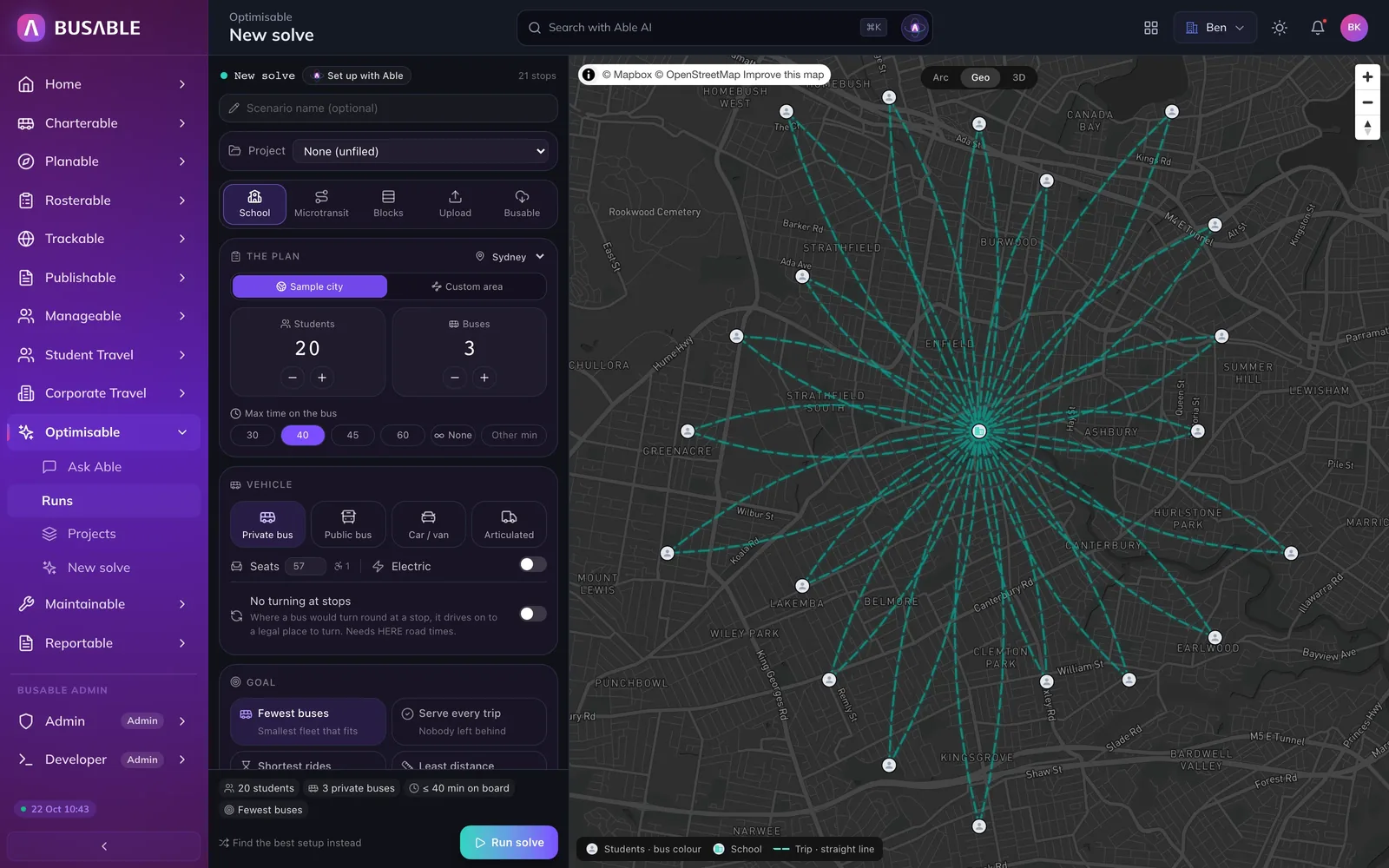
The students, the buses, the longest ride you accept and what matters most, fewer buses or shorter rides, sit on one screen with the students mapped around the school.
See the routes on the roads
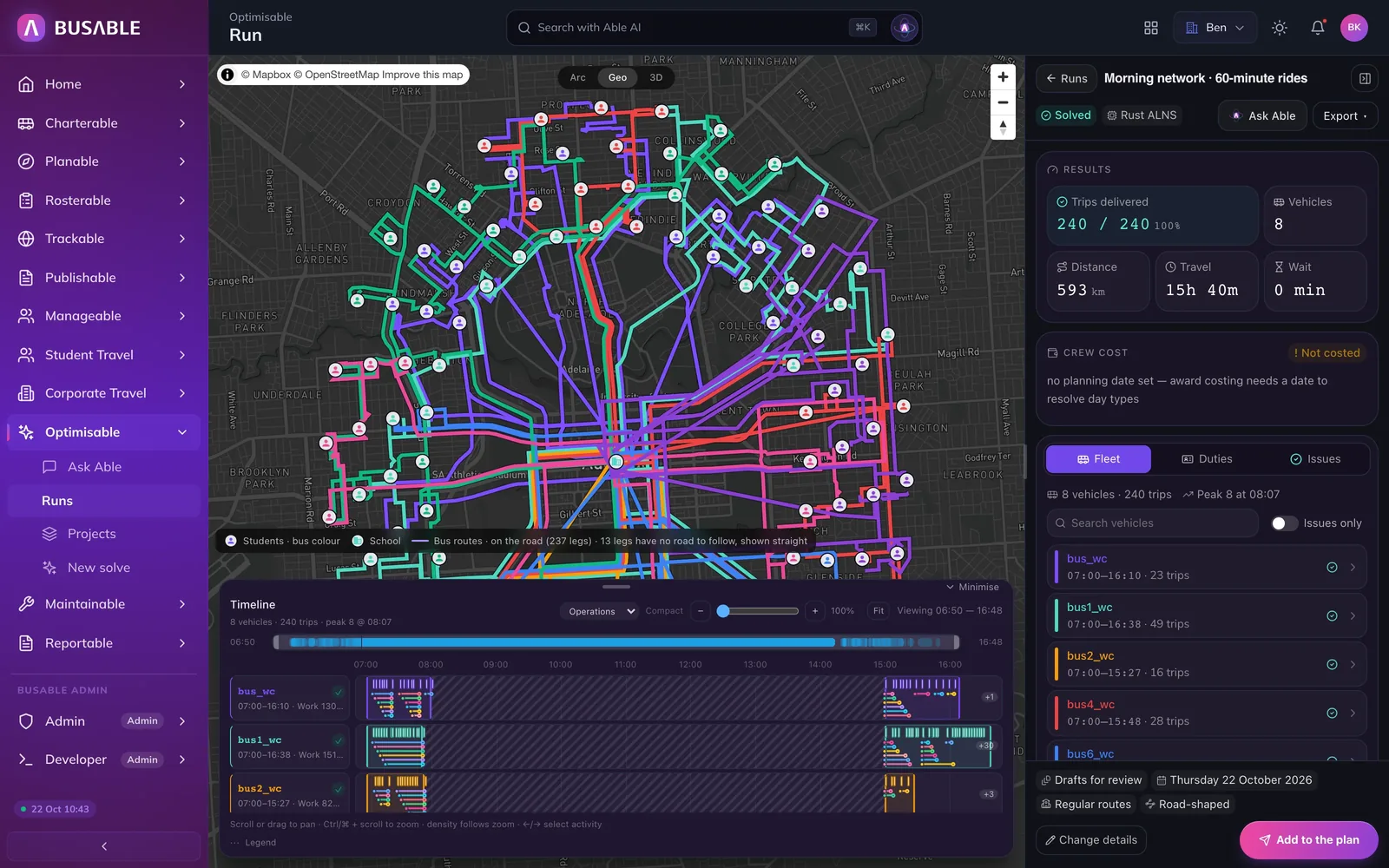
Each bus gets its own colour on the map and its own line on the timeline, with the trips delivered, the buses used and the kilometres driven in the totals.
Compare before you change anything
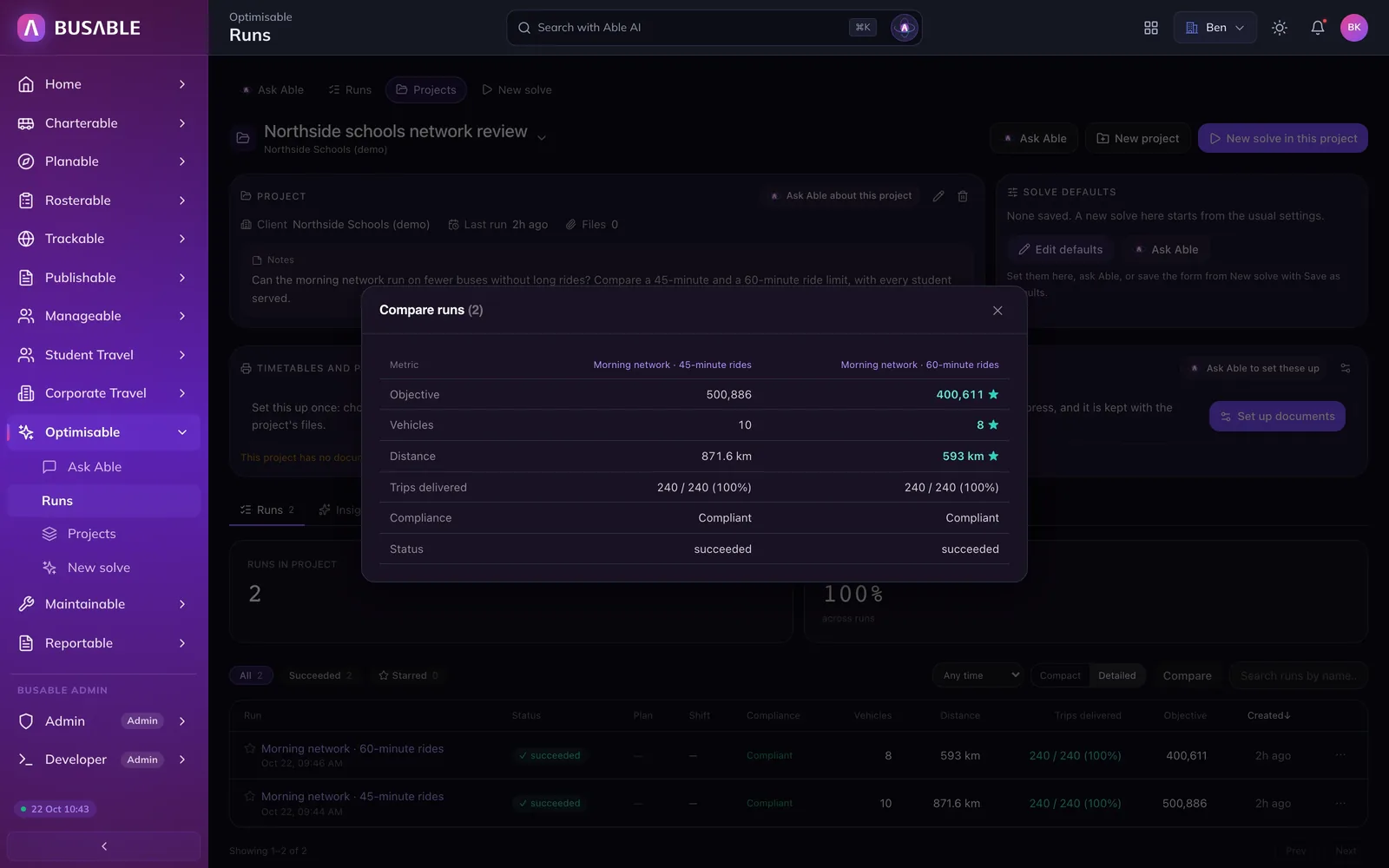
Change the ride limit, the bus sizes or the arrival window and line the answers up side by side. You see what a shorter ride costs in buses and kilometres before you ask a school or a family to accept a change.
When you choose a plan, the routes go to Planable as drafts and the duties to Rosterable, ready to allocate. Nothing is published until you check it.
Frequently asked questions
How do I work out how many buses a school run needs?
Count the buses on the road at the busiest moment of the morning and of the afternoon, and take the larger of the two. That number depends on the bell times, how early buses may arrive, the longest ride you accept, the size of your buses, where students board and the road times between stops, so test those together rather than one route at a time.
Does a longer ride limit mean fewer buses?
Usually. A longer ride lets each bus collect more students before school, so the same students fit on fewer buses. The cost is a longer trip for the students picked up first, so compare both before deciding.
Why plan on road travel times instead of distance on a map?
Straight-line distances understate how long a bus takes. Road travel times for buses, and turns a bus can legally make, give running times and kilometres close to what the bus will drive, which is what the contract is priced and the bell is met on.
What does Optimisable do with the answer?
Optimisable™ compares the options side by side on buses, kilometres and trips delivered. The plan you choose goes to Planable™ as draft routes and to Rosterable™ as duties ready to allocate, and nothing is published until you check it.
See how many buses your school runs need
Send us your student list and fleet list and we will show you what Optimisable finds.
Book a demo